
Golf is a sport where accuracy, planning, and consistency are paramount. As many golfers tend to focus on their driving distances or putting statistics, there is an indicator which has proven to be one of the best metrics related to scoring: GIR, or Green in Regulation.
Regardless of whether it is a weekend golfer who tries to beat his 90 stroke mark or a tour-level professional who plays in major tournaments, this measurement can help achieve better results. However, many people are not quite familiar with what Green in Regulation means, why it is so important, how it should be calculated, or how one can improve his results.
The following guide provides you with all the information that you might require about the term “Green in Regulation” and its role in golf.
What Is Green In Regulation or GIR Golf?
GIR is the acronym for Green in Regulation.
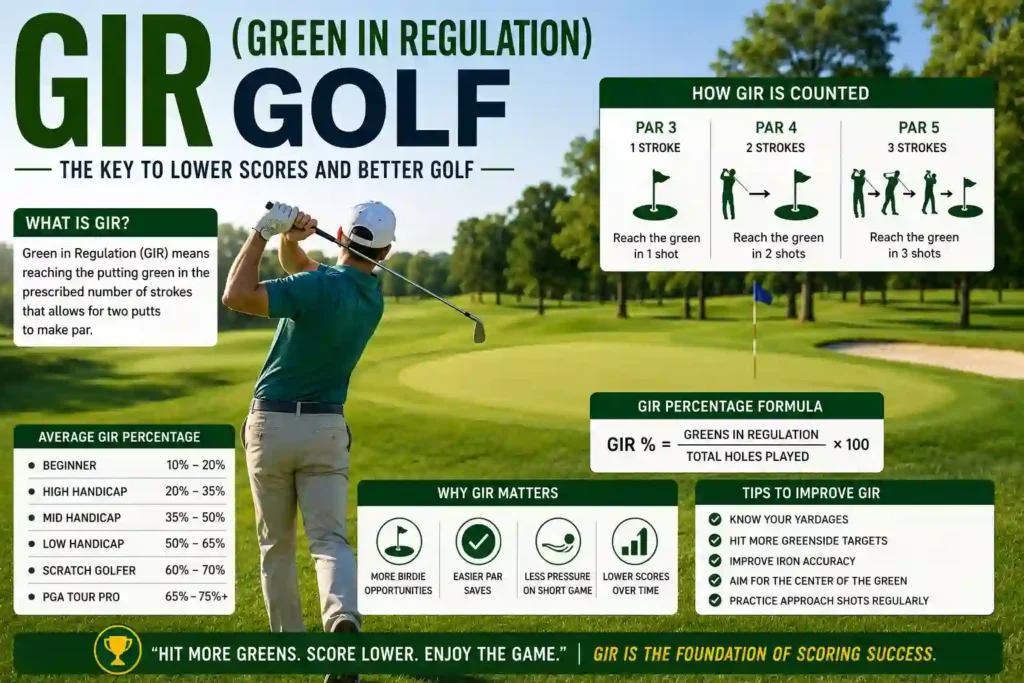
In other words, a golf player achieves a GIR when he/she manages to reach the green area within the allowed number of shots to make par.
It means that:
A shot on the green counts as a GIR Golf if it is:
- One shot for a par 3 hole
- Two shots for a par 4 hole
- Three shots for a par 5 hole
This way, a golfer who hits his/her ball in regulation will have two putts left.
Understand GIR (Green in Regulation)
Let us explain how this statistical category works through several examples.
How GIR Works: Par 3 Example
A golfer hits the tee shot directly onto the green.
As a result:
- The green is reached in 1 shot;
- The shot counts as a GIR.
How GIR Works: Par 4 Example
A golfer does the following:
- Hints his/her driver into the fairway;
- Hits the approach shot onto the green.
Thus:
- The green is reached in 2 shots;
- The shot counts as a GIR.
How GIR Works: Par 5 Example
A golfer does the following:
- Hints his/her drive into the fairway;
- Hints the ball again in the second shot;
- Gets his/her ball on the green in the third shot.
As a result:
- The green is reached in 3 shots;
- The shot counts as a GIR.
Why Green in Regulation or GIR Golf Is Crucial
According to many golf instructors, GIR is one of the most critical statistics since it positively impacts a golfer’s scoring ability.
The fact is that when golfers hit more greens, they get:
- More birdie opportunities
- Easier pars
- Fewer pressure shots
This is why players who consistently hit greens always tend to produce better scoring results compared to those who mostly rely on their recovery shots.
How To Calculate GIR Golf Percentage
The GIR percentage is calculated using a simple formula:
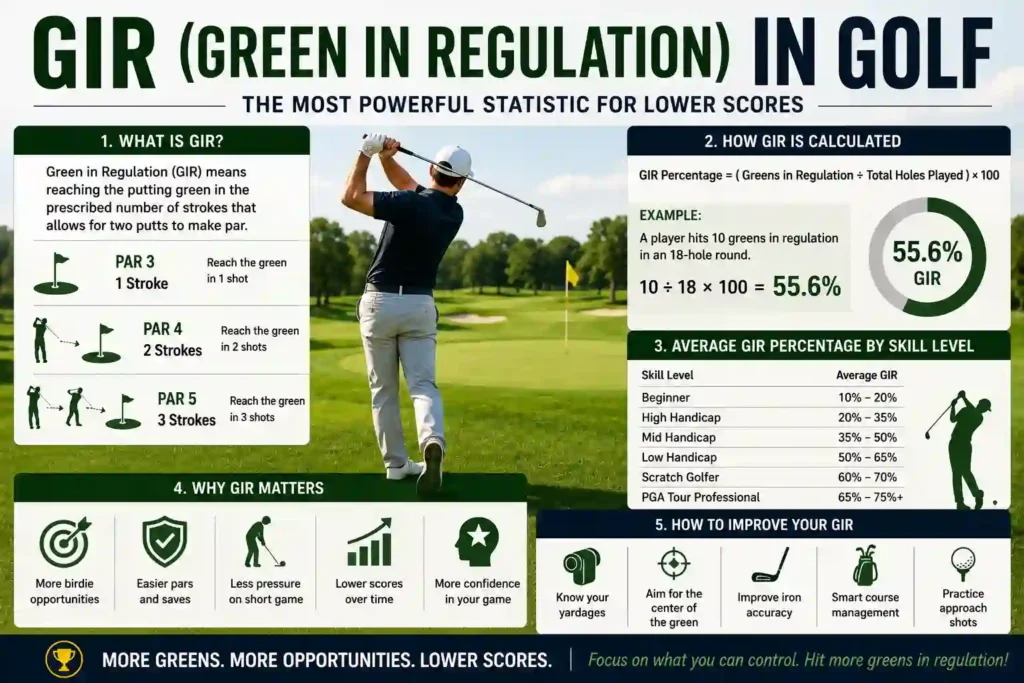
GIR Percentage = (Greens Hit in Regulation ÷ Total Holes Played) × 100
Example
If a golfer hits:
- 10 greens during 18 holes of play
The calculation goes as follows:
- 10 ÷ 18 × 100
Thus:
GIR Percentage = 55.6%
It means that a golfer achieved 56% GIR.
Green in Regulation by Player’s Level
Here are GIR Golf percentage examples for different levels of skill.
| Golfer Level | Average GIR Percentage |
|---|---|
| Beginner | 10–20% |
| High Handicap | 20–35% |
| Mid Handicap | 35–50% |
| Low Handicap | 50–65% |
| Scratch Golfer | 60–70% |
| PGA Tour Professional | 65–75%+ |
These percentages illustrate why GIR golf is such a valuable indicator of skill level.
GIR Golf and Scoring Relationship
There is a strong connection between GIR and scoring average.
Generally:
More GIR = Lower Scores
Golfers who consistently hit greens:
- Face shorter putts
- Make more birdies
- Avoid difficult chips
- Reduce double bogeys
Even if putting remains average, hitting more greens often leads to significant score improvements.
Why Pro Golfers Follow This Statistic
Professional players analyze dozens of statistics but always pay close attention to GIRs.
Some of them calculate:
- Overall GIR percentage
- GIRs from certain distances
- GIRs per various holes
- GIRs in high-pressure situations
These statistics help to understand pros’ strong and weak points throughout the season.
A Brief History of Green in Regulation
Green in Regulation has been used as a measurement tool in this sport for decades.
Back in the days, without any advanced analytics, coaches and players mostly analyzed such key statistics as:
- Fairways hit
- Greens in regulation
- Putts per round
Even nowadays, despite new analytics data, GIR still stays relevant.
GIR Golf vs Fairways Hit
Most golfers tend to assume that driving accuracy is more valuable than GIR Golf.
Although hitting fairways is critical, GIR usually has a greater correlation with the scores.
Fairways Hit Measures:
Driving accuracy
GIR Measures:
- Approach efficiency
- Shot striking proficiency
- Score opportunities
Golfer can fail to reach numerous fairways but still hit lots of greens and score effectively.
GIR vs Strokes Gained
Modern golf analytics introduced the concept of strokes gained.
GIR
Checks if the green was reached in regulation.
Strokes Gained
Measures the performance relative to other players.
Though strokes gained provide more detailed statistics, GIR is simpler to track for recreational players.
Benefits of Increasing GIR Golf Percentage
Some significant benefits can result from improving GIR stats.
More Birdie Opportunities
Getting closer to the hole increases birdie chances.
Easier Par Scores
Two putting the ball from the green surface is less difficult than scrambling from rough areas or bunkers.
Less Stressful Chipping Shots
Professional golfers who hit more greens do not have to depend on miraculous chipping recovery.
Higher Self-confidence
Frequent success with GIR boosts self-trust.
Reasons why Players are Missing Greens
Identifying the reasons helps one to know what areas require improvement.
Bad Distance Control
Missed greens happen due to the fact that approach shots fly:
- Too short
- Too long
Proper control of distance is critical.
Inaccurate Iron Shotmaking
Iron approaches may also be missing:
- Left side
- Right side
- Short-sides
By fixing this problem, one will improve GIR.
Bad Course Management
Many misses occur due to risky aggressive play.
Golfers need to focus on:
- Safe spots
- Middle of the green surface
- High percentage targets
- Mental Mistakes
Such factors as pressure, frustration, and lack of concentration make people commit extra mistakes.
Ways to Improve Green in Regulation Percentage
Improve Iron Accuracy
Most of the times the GIR Golf performance is defined by approach shots.
Exercises include:
- Targeting drills
- Alignment work
- Distance control exercises
Know Exact Yardages
Many players underestimate exact yardages.
Measure:
- Exact carry
- Full yardage
- Normal shot pattern
Information provides more accurate selection of clubs.
Hit the Middle of the Green
Recreational golfers are aiming at challenging pin locations.
Hitting the middle part:
- Reduces danger
- Improves GIR Golf percentage
- Improves scoring consistency
Improve Driving Position
Improved drive means easier approach shots.
Practice:
- Driving accuracy
- Effective ball striking
- Position of drive on the course
- Practice Approach Shots
Spend practice time working on:
Approach shots ranging
100–150 yards
Most frequently used distance.
150–200 yards
Critical for longer par 4s.
Various wedge shots
Required for attacking flagstick.
GIR Golf for Players of Various Skill Levels
Beginners
Practice:
- Proper club striking
- Basic distance control
- Avoiding hazards
Avoid attacking hard pin spots.
Intermediate Golfers
Should develop skills of:
- Course management
- Approach shot efficiency
- Avoidance of major misses
Low-Handicap Golfers
Need to concentrate on:
- Exactness
- Shaping of shots
- Optimization of distance
Improvement of these skills can greatly increase the score.
GIR Golf on Different Hole Types
Par 3 holes
Dependence on accuracy of tee-shot.
Par 4 holes
Requirements:
- Proper drive
- Accuracy of approach
Majority of GIR occurrences takes place at par 4.
Par 5 holes
Highest chance of scoring birdie.
Players usually reach greens with:
- Two shots
- Three shots
Performance of par 5 directly impacts GIR statistics.
Effect of Weather on GIR Golf
Different conditions greatly influence Green in Regulation performance.
Wind
Making club choice difficult.
Rainfall
Changes the flight trajectory and ability of the ball to stop.
Firm greens
Make the task of stopping the approach more difficult.
Low temperature
Reduce carry distance.
Smart adjustments help maintain GIR performance.
Equipment and GIR Golf
Some equipment elements affect greens hit in regulation.
Irons
Forgiving irons help a golfer:
- Get consistency
- Boost launch angles
- Gain distance control
Golf Balls
Good balls help a golfer to achieve:
- Better spin control
- Greater stopping ability
- More accurate approach shots
Rangefinders
Knowing distances allows golfers to select the appropriate clubs more often.
GIR Golf and Scratch Golfers
Golfers playing at a scratch level usually hit far more greens in regulation.
Characteristics of such players are:
- Great distance control
- Excellent ball striking
- Smart target selection
- Mental discipline
And this is why scratch golfers regularly shoot even scores.
Can You Score Good Without High GIR?
Absolutely, but it is harder.
Short-game specialists might:
- Hit the green with chip shots
- Save pars with putts
- Overcome mistakes on the approach shots
However, totally depending on your ability to scramble is not an efficient tactic.
Good scores are usually achieved with high GIR percentage.
Professional Golf and GIR
When it comes to professional golf, GIR still matters.
Many tournament winners rank among the best golfers in:
- Greens hit
- Approach shots
- Ball striking
Pro players are aware that managing approach shots brings many scoring opportunities.
Conclusion
The statistic known as “Greens in Regulation” is among the best in the game of golf. It is important because of how much insight into the ball striking and approach skills that it provides about a player. While some focus on their driving or putting abilities, GIRs have become an important indicator of success on the golf course.
If players are hitting greens in regulation, then they are giving themselves many opportunities for birdies and pars while limiting the importance of their short games. This applies whether you are trying to get below a hundred strokes or are close to earning your scratch status.
It is a statistic worth working on as a player regardless of your current ability level.
FAQ About GIR Golf
What does GIR mean in golf?
GIR means Greens in Regulation.
How many shots do you need for GIR on par 4?
A golfer needs 2 strokes to reach the green in regulation on a par 4.
Why is GIR significant?
As it measures the effectiveness of reaching the putting area and creating scoring chances, GIR is important.
What GIR is expected for amateurs?
A mid-handicapper might be satisfied with 35%-50% GIR percentage.
Do professionals monitor GIR?
Certainly, because GIR is one of the most essential statistics for them.
Is GIR more influential than driving distance?
In many cases, GIR has a better correlation with scores than driving distance.
How can I increase my GIR?
With better iron shots, accurate yardages, more efficient practice, and improved course management.
Is it possible to make birdies without GIR?
It is possible, but most opportunities appear after a GIR shot.
Also, Read: What Is a Scratch Golfer | How Many Golfers Make the Cut at the Masters | What Clubs Does Rory McIlroy Use | Best Golf Books | Callaway Rogue Driver