
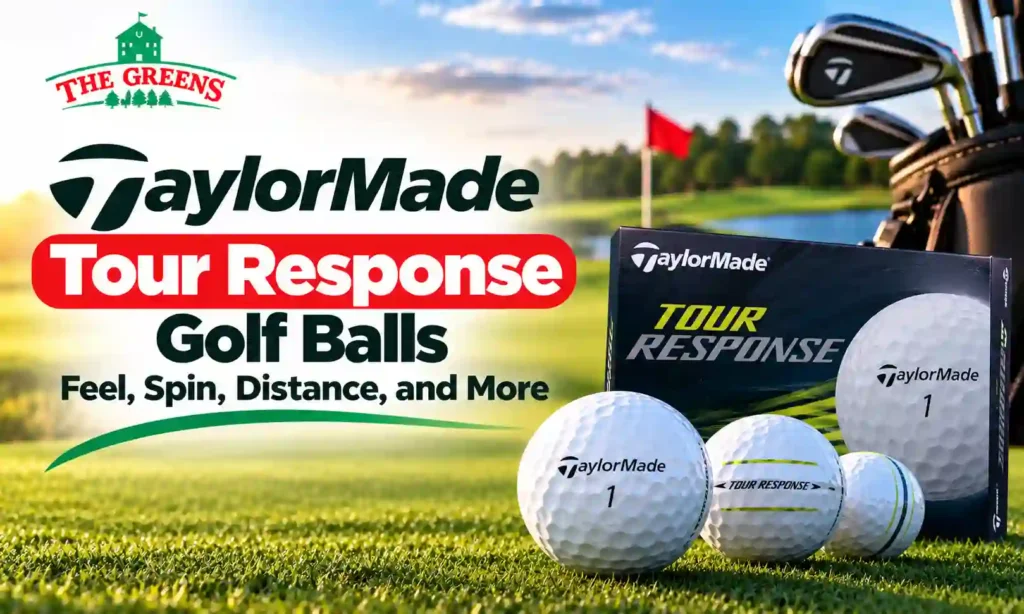
TaylorMade Tour Response golf balls are product that caters to the needs of golfers looking to have a softer ball and better greenside performance than what is offered by distance golf balls, while still not quite getting into the premium TP5 line by TaylorMade. The 2026 model of the ball is composed of three layers, has a cast urethane cover, and has a compression of around 70.
This makes Tour Response a good choice for those looking for a ball that strikes a balance between performance and price. With better greenside performance compared to many distance golf balls, while being softer than many tour balls, whether TaylorMade Tour Response golf balls are worth purchasing can depend on what matters the most to you in your game.
TaylorMade Tour Response Golf Balls at a Glance
| Feature | What to expect |
|---|---|
| Construction | Three-piece golf ball |
| Cover | 100% cast urethane |
| Compression | Approximately 70, depending on measurement method |
| Feel | Soft, particularly on short shots and putts |
| Main strength | A blend of distance and greenside control |
| Available versions | Standard Tour Response and Tour Response Stripe |
| Best suited to | Golfers who want a softer urethane ball without paying flagship-ball prices |
| Potential drawback | Costs more than basic two-piece distance balls |
Tour Response 2026 from TaylorMade has an even finish designed to help optimize the aerodynamics of the golf ball. If you are buying online, pay attention to the year of production – there may be new and old “Tour Response” on sale.
What Makes Tour Response Different?
One difference between Tour Response and regular budget golf balls lies in a soft urethane cover. Usually, cheaper models come with harder ionomer cover. Urethane material provides better opportunities to grip the ball in the groove of your wedge when you strike it, creating spin and stopping the ball quickly.
Nevertheless, do not expect to hit the perfect pitch without any efforts. Clean strike, club, golf ball, lie, and greens quality influence the spin; Tour Response only helps you to get the maximum control in a good shot.
Three-Layer Construction
Tour Response has a core, a mantle layer, and an external cover. Such construction tries to maximize the ball speed with the softer feel and greater control with scoring clubs.
TaylorMade’s Speed Wrapped Core and SpeedMantle contribute to such an attempt. Names show the philosophy of the company about speed and feel of their golf ball, but it is still up to your launch conditions and ball striking.
Soft Feel and Compression
Tour Response is about 70 compression. The compression of a golf ball shows how it compresses under the testing load but does not represent the full performance of a ball. Even two balls with similar compressions can act differently due to different covers, layers, and aerodynamics.
Also, you do not have to use the driver in one speed to test Tour Response. Moderate-speed golfer can like its feel but other players should evaluate the performance of the ball rather than the swing speed.
Microcoating 2026
The update to 2026 comes with microcoating. Microcoating helps to achieve even application of the outer cover all over the ball surface, including dimples. The goal of such a manufacturing change is to make the aerodynamics of the ball work consistently.
This is an improvement for the manufacturing process, not for golfers. It does not guarantee that you will see a great distance increase.
How Do Tour Response Balls Perform?
Off the Tee
Tour Response is made to combine high ball speed and soft feeling. Golfers who do not like sharp feel of the firmer golf balls can feel comfortable playing with the driver.
Do not confuse “soft” feeling with “straight” shots. Incorrect swing or wrong angle of your driver’s face can lead to misses. If the only problem you want to solve is lost golf balls, a cheaper model may be more practical.
On Iron Shots
On iron shots, Tour Response is supposed to combine high distance and stopping power for the greens. For some golfers, it can be easier to feel the ball because of softer sound and feel.
But pay attention to what happens after your hit and not to the feel itself. How far do your 7-iron fly? Does the ball stop close to where it has landed, or does it release? The answers to those questions are much more helpful than just general statements like “ball spins more”.
Around the Green
Here the soft urethane cover can play the key role. In the case of clean chip and pitch, Tour Response can produce more spin and predictable stopping than distance ball with the ionomer cover. Also, independent reviews say that 2026 model of Tour Response has good stopping around the green but it depends on you and conditions.
Just compare several pitches from the same place with the Tour Response and your usual ball. Try to make similar swings to avoid comparison of hits rather than balls’ performance.
On the Putting Green
Feel of the putter is individual. The soft sound of Tour Response makes some golfers more comfortable but others may find it less informative than a click of the firmer ball. The standard version of the ball has a standard appearance; Stripe model provides additional visual cue.
Tour Response vs. Tour Response Stripe
Response Stripe Tour Ball is essentially the same ball used for performance but with the added feature of the 360-degree alignment stripe. The Response Stripe Tour may assist in aiming and judging how accurately the ball will roll in the direction that you have aimed.
| Feature | Standard Tour Response | Tour Response Stripe |
|---|---|---|
| Core performance design | Three-piece urethane construction | Three-piece urethane construction |
| Appearance | More traditional look | Wide alignment band around the ball |
| Putting alignment | Standard printed markings | Highly visible 360-degree reference |
| Best for | Players who prefer a clean look | Players who want more visual feedback |
| Typical cost | Usually lower | Usually slightly higher |
The Stripe is simply a preference. Should a thick line aid in commitment towards the goal, it may come in handy. Otherwise, the normal Stripe may suit you better.
As for 2026, TaylorMade brought about new Stripe color options, which include Clear and Mint. The colors and availability vary from retailer to retailer.
Tour Response vs. Other TaylorMade Balls
| Ball | General character | Consider it if… |
|---|---|---|
| Tour Response | Soft-feeling, three-piece urethane ball | You want greenside control at a price below the flagship range |
| Tour Response Stripe | Tour Response with a prominent alignment band | A bold visual aid helps your setup and putting routine |
| TP5 | Flagship five-layer tour ball | You want to test a premium ball with a different full-swing and short-game profile |
| TP5x | Firmer-feeling flagship five-layer ball | You prefer a firmer response and want to compare launch and spin in a fitting |
| SpeedSoft | Lower-cost, soft-feeling ionomer ball | Price and soft feel matter more than urethane-cover greenside spin |
| Distance+ | Value-focused distance ball | Keeping the cost of each round down is the priority |
The higher price does not necessarily mean the ball will perform better for you. If Tour Response gives you the trajectory and stopping power you seek, switching to TP5 or TP5x won’t make your game better. Similarly, if you do not see much difference in approach shots, the more expensive ball is likely to cost you more without adding value.
Who Is It Best to Play With Tour Response Golf Balls?
The ball is worth your attention if you:
- Seek a urethane cover but prefer a softer feel.
- Require more control in chipping and pitching than regular distance balls give.
- Play often enough to recognize how your ball acts during approach shots.
- Want to compare the mid-level ball with top tier tour golf balls.
- Seek a good alignment marker and consider buying Tour Response Stripe.
- Is not recommended for those who:
- Get lost a lot of balls and require the lowest possible price per round.
- Prefers distinctly firm feel when playing the ball with putter and irons.
- Already found a ball providing better launch, carry and stopping power.
- Dislike the stripe appearance and consider the Stripe ball just for that.
There is no universal handicap that will suit this ball. It is perfectly fine to find the ball ideal for a beginner but not appropriate for a veteran and vice versa. What counts is the functions the ball allows you rather than your skill level.
Are Tour Response Golf Balls Worth the Money?
Yes, in case of those who rely on the cover’s control in their short game. Tour Response is situated between cheap two-piece balls and the company’s expensive TP5 line. In 2026, the standard ball cost approximately $42.99 per dozen in the United States. The Stripe was about $45.99 per dozen; prices might vary.
The difference in cost becomes relevant if you are losing a lot of balls during play. For example, if you are losing a ball per round, you have to take this factor into account. If your ball lasts for several rounds and provides additional confidence around the green, it might be worth paying extra for it.
Don’t pay extra only for the word “tour” in the description. Seek the ball providing the specific benefits for your game like reliable iron carry, preferred trajectory, predictable chip release, and comfortable putting feel.
How to Test Tour Response for Your Game
A brief on-course test can provide you with more information than the judgment after just a couple of drives.
- Start at the green. Play short chips and 30 to 50 yard pitches using Tour Response and your regular ball. Notice landing and rollout differences.
- Check the approach distance. Hit several shots using the same club and mark the carry, height and stopping power of each ball.
- Practice putting from different distances. Notice the sound and speed of the balls. In case of Stripe, pay attention to the alignment marker.
- Perform tests with the driver last. Compare your usual shots, not the longest one you’ve made.
- Keep the influence of environmental factors in mind. The results might differ greatly under the wind, low temperatures, wet grass, firm greens and other circumstances.
If possible, test the ball during multiple rounds. Sometimes you need several attempts to estimate the performance of the ball accurately.
Frequently Asked Questions
Are TaylorMade Tour Response golf balls good?
Yes, for golfers seeking a soft-feeling urethane ball with useful greenside control at a lower price than TaylorMade’s flagship tour models. Whether they are right for you depends on your ball flight, preferred feel, and budget.
Is Tour Response a three-piece golf ball?
Yes. The current model uses a three-piece construction with a cast urethane cover.
What is the compression of Tour Response?
TaylorMade describes Tour Response as a low-compression ball at about 70 compression. Independently measured figures can differ because testing methods are not identical.
Does Tour Response spin around the greens?
Its urethane cover is designed to provide greenside spin and control. The amount of spin you produce still depends heavily on contact, club, lie, and conditions.
Is Tour Response Stripe different from the standard ball?
The main difference is the Stripe’s bold 360-degree alignment graphic. It is intended to help with aiming and visual feedback rather than to create a different ball-flight profile.
Is Tour Response better than TP5?
Not for everyone. TP5 and Tour Response have different constructions and feel. Tour Response may be the better value if it gives you the flight and short-game response you want; TP5 may be worth testing if you are seeking a different performance profile.
Is Tour Response suitable for beginners?
It can be, especially for a beginner who wants to develop touch around the greens. However, someone who loses several balls each round may prefer a lower-cost option while learning to keep shots in play.
How long does a Tour Response ball last?
There is no set number of holes. Inspect the cover after bunker shots, tree strikes, and cart-path contact. Replace the ball if it has a significant cut or damaged surface, or if you notice inconsistent flight.
Final Verdict
TaylorMade Tour Response is a strong choice for golfers who want a softer ball without giving up a urethane cover. Its appeal is the combination of pleasing feel, capable all-around performance, and short-game control at a price below the brand’s flagship models. Choose the standard version for a traditional look or Stripe if a bold alignment aid genuinely helps you on the green.
The best test is simple: play a few rounds with Tour Response and compare it with the ball you already trust. If your approaches, chips, and putts become more predictable—and the price fits your budget—it has earned a place in your bag.
Also, Read: What Is the Diameter of a Golf Hole? | What Does Dormie Mean in Golf | Byron Nelson Payout 2026 | AW Golf Club | Shamble Golf Format | What Degree Is a Pitching Wedge | What Is an Eagle in Golf | How Long Does It Take to Golf 9 Holes | Best Golf Courses in Wisconsin | Are Strata Golf Clubs Good